I had an accident going down some steps. This is maybe the fourth time I have hurt myself there. I rush about, distracted by something else I'm thinking about. Consequently, I don't pay sufficient attention to what I'm doing.
Friday, 12 September 2025
It's all kicking off, Sue
I had an accident going down some steps. This is maybe the fourth time I have hurt myself there. I rush about, distracted by something else I'm thinking about. Consequently, I don't pay sufficient attention to what I'm doing.
Tuesday, 2 September 2025
Wild fires in North Yorkshire
This is a screenshot of NASA's satellite FIRMs surveillance. It shows areas where thermal activity is taking place.
I've marked where our caravan is with a small black X (half way down, to the left). This shows the pass the satellite made on 28 August after the Fire Brigade put in fire breaks only 1,000 metres away to stop the fire spreading further North.
This photograph was taken from the static caravans on the other side of the road, our caravan is located just beyond the security barrier you can see at the top of the image. The Fire Brigade evacuated the site, roads around the site were closed whilst a "farmy army" of volunteers joined them and worked around the clock to keep settlements safe. It must have been a frantic time moving livestock to safer areas. At the time of writing, roads re-opened closest to our site only yesterday.
The fire stops worked and we're glad to say they halted the fire's progress. The Fire Brigade, farmers, National Trust rangers and volunteers have done an amazing job of preventing the fires from destroying settlements. We are very thankful.
Moorland, which will regenerate, has been scorched over a large area. We know many trees have been lost, some ancient woodland also destroyed, which is the most upsetting outcome, given how much wildlife it supports. I hope all the creatures were able to escape, inevitable that there must have been casualties. If we had lost the caravan - it can easily be replaced.
Only a few days before we heard about the fire, we had been up there walking on the moors. This is a photograph taken looking towards the alum mine which was also evacuated. The fire went right up to it, only halted on the opposite side of the road running by it due to the tireless good work of everyone involved.
The heather was out and everything was looking quite beautiful. Our thoughts and good wishes are with everyone who lives and works permanently in the area.
Saturday, 28 June 2025
Time slip
I was reading through a few blog posts to discover the date we moved into our latest home and I suddenly realised 2024 has been and gone and I posted nothing!
Furthermore, nearly half of 2025 has also vanished!
Amongst the biggest news is MTM is now working only 3 days a week. He ended up staying working for his employer despite handing in his notice. There then followed a period of uncertainty when - only a few short months after they begged him to stay - they seemed intent on forcing him to leave! As he had turned down the offer of another job opportunity, he saw a lawyer and filed an official complaint of constructive dismissal based on some very strong evidence of ageism. This led to a truce which has pretty much held since then.
We got another dog, Diesel, he was ten when we got him from Coningsby Rescue
I saw him on their Facebook page a few weeks after we lost Bongo. No-one had applied for him, he hadn't had a single application. My heart went out to him. We visited a couple of times and soon he was on his way to live with us. He's a very calm, placid Staffordshire Bull Terrier.
He's thirteen now, lately he has developed arthritis in his back legs which limits how far he can walk, bless him but we still love him to bits.
I'm still doing my crochet patterns and selling them on Ravelry and Etsy, here's the latest one, a zebra print striped blanket with a scarlet edging.
Earlier this year, we nearly bought a beach hut in Sutton on Sea
But we changed our mind and got a new (to us) caravan, it's about four years old. Here it is at Glossop caravans, the day we put our deposit on
We've got it parked on a seasonal pitch up on the edge of the North Yorkshire moors, with the seaside towns of Whitby and Robin Hood's Bay both only a very short drive away. We could easily walk to both if Diesel was up to trekking that far.
Wainwright's Coast to Coast route passes within a (long) stone's throw and the famous Cinder Path goes through a nearby village.
Here are our sunloungers in the generoisly sized awning, it's a very relaxing place to to crochet and drink wine!
I have grown my hair very long (for me) and post menopause, it's now really quite wavy!
Thursday, 18 May 2023
Cute little stitch marker
I haven't had to use a stitch marker on any projects lately but when I came to need one for this design-in-progress, I was very keen to give this one a go.
It was sent as a thank you gift by LauretteCraftsUK when I purchased one of their laser cut hat prop display cards some time ago. I loved it so much, it has been saved in my work box on the coffee table for just the occasion when I would need it.
It's a lovely little stitch marker, so lightweight (made from laser cut birch), it doesn't weigh your stitches down in the slightest so no stretching the stitch. Its metal pin closes securely so you know it's not going to fall off.
I have ordered a few more in a lovely tin so I don't run out (I'm going to need a few for this project). You can even get some in a teeny little sock shape! Do go and have a look at the perfect little designs in their shop - any knitter or crocheter would love any of these items as a gift.
Thursday, 9 March 2023
Binary double crocheting, photo tutorial using UK terms
|
When binary crocheting, it is best to start with a binary foundation row to start with. If you haven't already, see my Tutorial “Making A Binary Foundation Double Crochet Row” for how to do this. For the ear warmer/headband, 68 stitches are required. 272 for the scarf. Any number of stitches can be crocheted using this technique so reduce and increase as you wish. For binary crocheting, it is recommended that you use a size of hook at least one size up from that recommended for the yarn. Perhaps two sizes up for yarn thicker than 4-ply. The yarn used in this tutorial is DK weight and the hook is 6mm (J/10). Gauge is 14 sts and 16 rows makes a 4 in/10 cm square worked in pattern with two strands of DK yarn. |
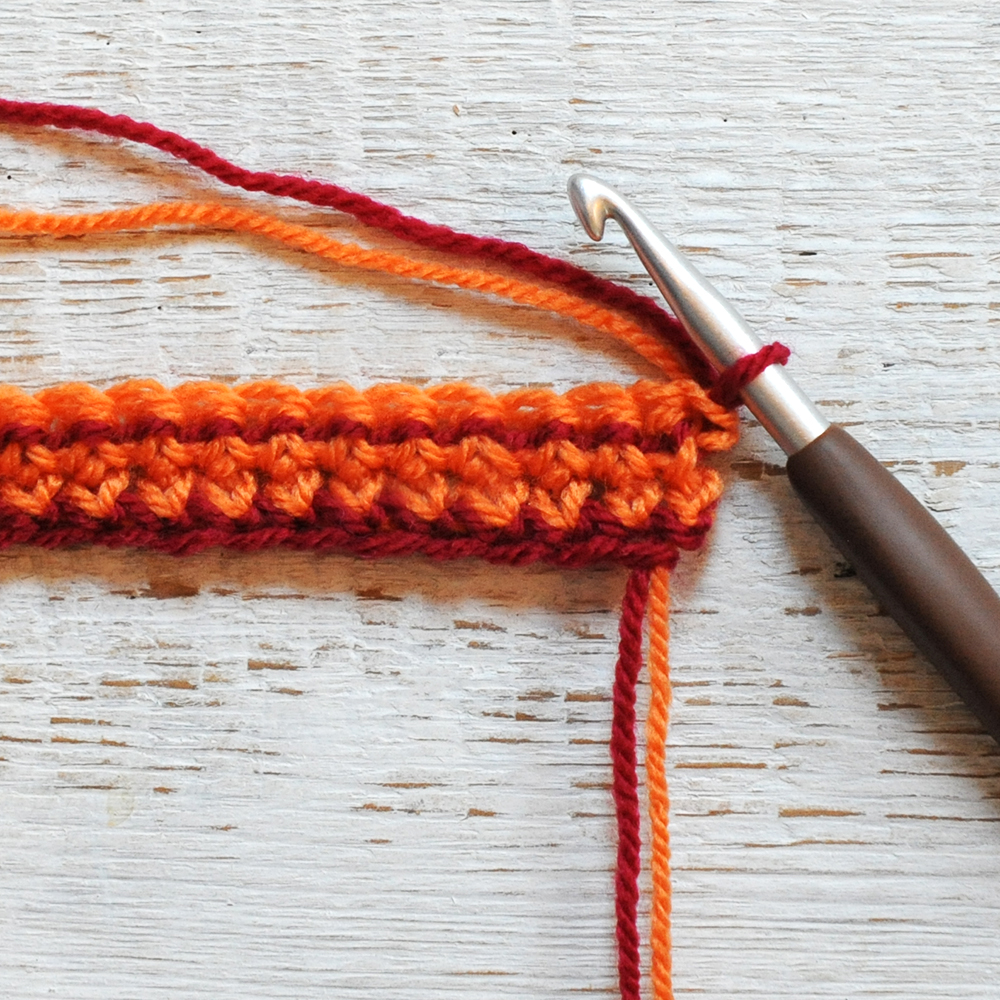
| Step 22 In this example, orange is referred to as the “dominant yarn” and red the “supporting yarn”. After making the binary foundation double crochet row for the necessary number of stitches called for in the pattern, we need a binary turning chain. With supporting yarn, yarn over from below hook going from front to back |
|
| Step 23 With dominant yarn, yarn over from above hook going from back to front. |
|
| Step 24 Pull dominant yarn through two loops (one loop remaining on hook). You have completing a binary turning chain. You need to make one at the start of every new row of binary double crochet. It does not count as a stitch. Turn. |
|
| Step 25 Position the binary foundation double crochet row to your left and hook on the right. Keep the supporting colour parallel to the chain as if you were about to crochet over it. Insert hook into the two uppermost dominant coloured loops of the first stitch as indicated by the darning needle. Ensure hook goes under the strand of supporting colour yarn. |
|
| Step 26 With dominant yarn, yarn over from above hook going from front to back. |
|
| Step 27 Pull dominant yarn through stitch (two loops on hook). |
|
| Step 28 Using the supporting colour, yarn over from below hook going from front to back (three loops on hook). |
|
| Step 29 Using dominant colour, yarn over from above hook going from back to front and pull through all three loops (one loop remaining on hook). |
|
| Step 30 You have almost completed one binary double crochet stitch. Before making the next stitch, give the supporting yarn (red) a gentle tug to take up the slack, not too much. Don’t worry about exactly how much for now. I will be giving you some tips on how to achieve the perfect tension for your supporting yarn a little further along. |
|
| Step 31 Insert hook through both loops of the next stitch (as indicated by the darning needle - it looks like there’s only one but the second is obscured behind the first loop). Ensure hook also goes under the strand of supporting colour yarn. To make further binary double crochets, repeat Steps 26 to 31. Do three or four more stitches and then I want to give you some tips to help neaten your binary crochet. |
|
| Video for Steps 22-31 | |
| Too loose? Turn your work over to inspect the other side. Depending on how tightly you tugged on the supporting yarn at the end of step 9, it could look very different to how we really want it to. The photo to the right shows we didn’t tug hard enough (or at all) and the tension on the supporting yarn is too loose. |
|
| Too tight? This photo shows the tension is too tight, the supporting coloured loops are pinching the dominant colour too much, you can’t see enough of the supporting colour. In extreme cases, the supporting yarn might disappear into the dominant yarn altogether. |
|
| Just right This is how we ideally want it to look, the supporting yarn looks like a series of dashes, sitting snugly below the dominant coloured loop above it. Neither too tight nor too loose – this is the goldilocks zone, “just right” is what we’re aiming for. It takes a few practice rows to get to know how hard to do that little tug on the supporting yarn at the end of making the stitch. |
|
| Practice makes perfect. Keep doing this row and frogging it (unravelling) until you’re happy with how it looks. When you’re proficient and wanting to be able to work faster at binary double crocheting, you may want to do all your tensioning of the supporting yarn before you do the next supporting yarn over (just before step 28 rather than as part of step 30). | |
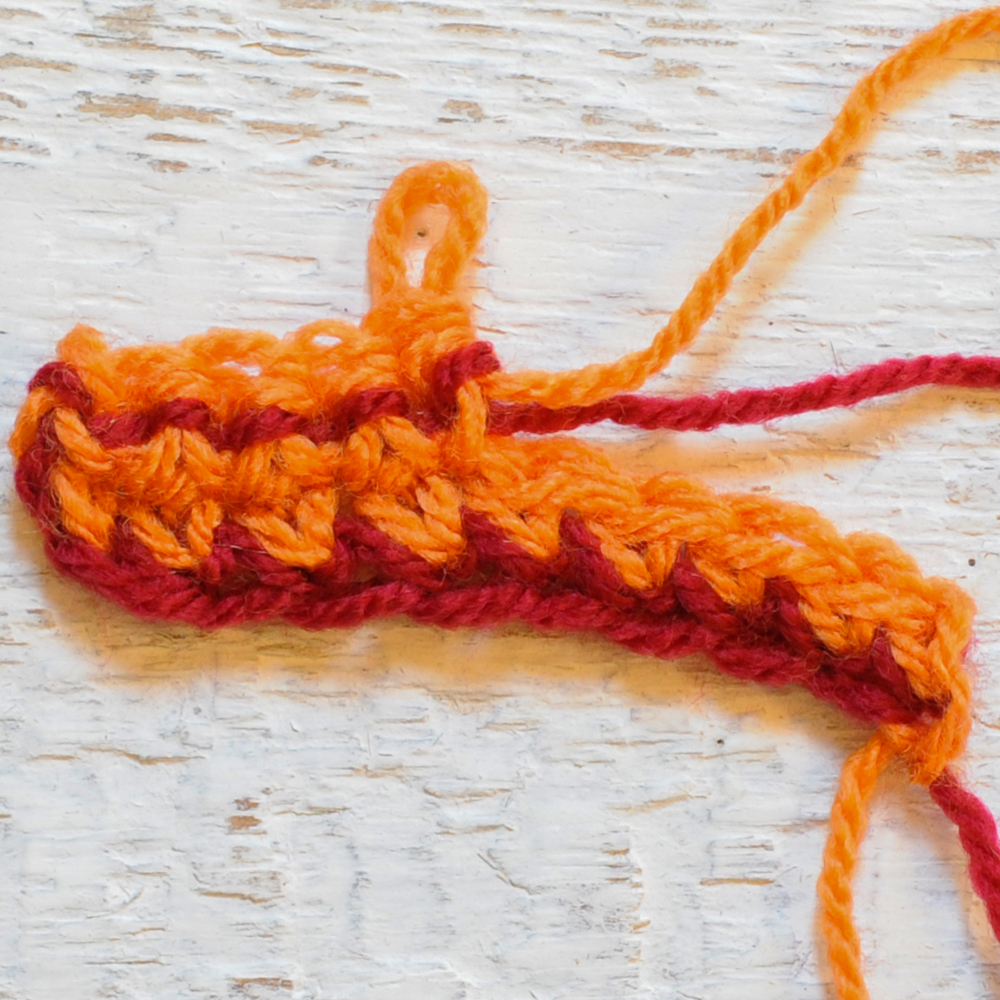
Rows 4 and 5 So far on the ear warmer/headband, we have made two rows using orange as dominant and red as supporting. For the next two rows, we are going to swap the dominance, making red the dominant colour and orange the supporting colour. This is achieved very simply. At the end of the second row, move the orange yarn down so it is underneath the red yarn |
|
| Work your binary turning chain (yo with orange first and then red), turn and then continue as you did with the second row. The only difference will be the yarn colours will be swapped over. Work two rows with red as dominant and orange supporting |
|
Rows 5 and 6 – Swap back to orange dominant and red supporting for these two rows. Keep alternating dominance every two rows until 17 rows have been completed Cut tails, weave in three of the tails, leave one in the corner long enough to sew the open ends of the ear warmer/headband together (approx 18 in /45 cm). |
|
| Sewing up Fold the ear warmer/headband in half lengthwise with whichever side you prefer inside the fold. Shape it into a capital U with the fold on the outside as shown on the photograph. |
|
| Grasp an end with each of your hands, holding between your thumb and two forefingers, interleaf one end into the other end as indicated in the photograph. | |
| Sew through all four layers of the ends, catch two loops on each layer. Work your way along with the stitches going up and down all along. Weave in the final end and then carefully cut yarn off close to your work. |
|
| Turn the ear warmer/headband inside out so the stitches are inside and try it on! | |
SCARF INSTRUCTIONSThe scarf photographed measures 62 in x 8.5 in (157.5 cm x 22 cm) excluding fringe and requires 272 stitches on your Binary Foundation Double Crochet row. To alter the length of the scarf, you can add or subtract as many sts as you like.To make the scarf in two colours, follow this tutorial's instructions for the ear warmer/headband, ie 2 rows with orange (say) dominant and red (say) supporting, the following two rows with red dominant and orange supporting. Continue alternating every two rows. To make a version of the ear warmer/headband or scarf in the rainbow shades of the one photographed, you will need nine different colours. The paid for print-ready PDF pattern in my Etsy shop CLICK HERE contains a full list of the colours used and quantities, which rows are dominant and supporting. It also has a tutorial on how to change the supporting yarn colour. The paid for version includes a separate PDF document written entirely in US terms. | |
EXAMPLES | |
| Red dominant colour, orange supporting on every row Both sides are the same | |
| Red and orange take turns at being dominant, changing on every row Back and front subtly different but both look attractive | |
| Red dominant for two rows, next two rows orange dominant, repeated More pronounced difference between the two sides, both very interesting | |
| Have fun coming up with your own variations! | |